
JA-150ST
Service explanation for JA-150ST
Wireless combined smoke/heat detector
This product is part of the JABLOTRON JA-100 alarm system. It provides indoor fire hazard detection. It is not intended for installation in an industrial environment. It contains an optical smoke detector and a temperature sensor. The optical smoke detector is very sensitive to larger particles, which occur in dense smoke, less sensitive to small particles, which occur in fires of liquids, such as alcohol. Therefore, it also incorporates a temperature sensor, which has a slower response, but is able to detect a fire with a small amount of smoke. The detector responds to the status (it reports activation and also calming of the situation). The product is intended to be installed by a trained technician with a valid Jablotron certificate.
Detector placement
Smoke enters the detector through the flowing air - therefore, it must be installed in a place, where the air flows well thanks to a natural thermal circulation (usually to the ceiling). The detector can be used only in an enclosed interior. It is not suitable there, where the smoke can spread and cool down (e.g. high ceilings - more than 5 m) - the smoke then does not reach the detector.
In homes, the detector should always be installed in the area leading to the exit (escape route) see Figure 1. If the floor area in the house exceeds 150 m², another detector must be installed there, in another suitable part of the house, see fig. 2.
1. kitchen,
2. living room,
3. - 6. bedrooms
? / minimum coverage by detectors
? recommended coverage by detectors
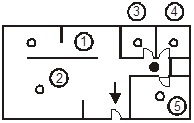
Figure 1
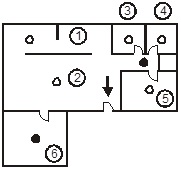
Figure 2
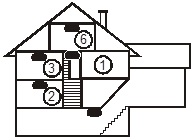
Figure 3
It is recommended to install a detector in every room, where people sleep.
Install under horizontal ceilings
If possible, install the detector in the center of the room. Since a cold layer of air may form near the ceiling, the detectors should not be recessed into the ceiling. The fire detector must never be installed in a corner of the room (observe a distance of min. 0.5 m from the room corner, see Figure 4). In corners, the air circulates poorly.
Install under sloping ceilings
If the ceiling does not have a suitable straight surface (e.g. an attic room), the detector can be installed according to Fig. 5.
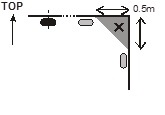
Figure 4
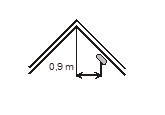
Figure 5
The center of the room, the best location, a possible location
Walls, partitions, obstacles, bare joists ceilings
The detector must be installed at least 0.5 m from a wall or obstacle. If the room is narrower than 1.2 m, the detector must be installed within the middle third of its width. If the room is divided into sections by furniture, shelving or half partitions, above which there is no more than 0.3 m distance from the ceiling, the individual sections should be considered separate rooms. In all Directions under and around the detector must leave a free space of min. 0.5 m. Any irregularity of the ceiling (such as a support beam), with dimensions greater than 5% of the ceiling height, are considered as walls where all the above remains in effect.
Ventilation and air movement
Detectors should not be installed directly at the outlet of ventilation, air conditioning and the like. If the air is introduced through a perforated ceiling, the ceiling must not be perforated 0.6 m in all directions around the detector.
Do not place detector:
- Where air flows poorly (niches, corners, ridges of ceilings on A-roofs and the like)
- Where dusty, smoky or steamy conditions prevail
- In places, where air flows intensively (close to fans, heat sources, mouths of ventilation, draught holes and the like.)
- in kitchens and damp rooms (steam, smoke and oily vapor may cause false alarms or detection failure)
- next to fluorescent or energy-saving lamps (electrical interference may trigger a false alarm)
- in places with large quantities of small insects
Caution: Most often, the detector becomes inadvertently active due to an incorrect installation location.
More detailed instructions for installation can be found in TS 54-14 and 34 2710.
Installation
When installing, follow the advice according to the previous paragraphs.
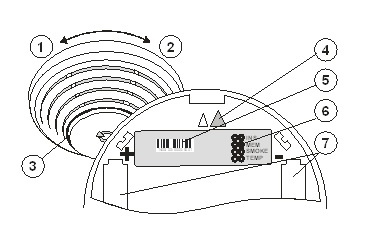
Figure 6: 1 - detach (remove) the detector; 2 - attach (set up) the detector; 3 - optical indication of status; 4 - orientation arrow for setting up; 5 - serial number; 6 - configuration junctions; 7 - place for inserting the batteries
1. Open the detector screen by turning it to the left (1).
2. Screw the plastic back panel to the selected location.
3. Set the configuration junctions (6) according to the table below
4. Continue to follow the installation instructions of the central unit. Basic steps:
a. In the F-Link program on the Peripherals card, select the desired position and start the learning mode with the Add button.
b. Inserting the last battery in the detector sends the learning code to the system - as confirmation of sending, the signal light (3) flashes briefly.
5. Place the detector on the plastic back panel. It can only be in one position, indicated by arrows (4) on both plastic parts. Turning the detector to the right (2) locks it in place.
Note:
The detector can also learn in the system by entering the serial number (5) through the F-Link program or through the keypad (or bar code reader). All digits below the bar code must be entered (1400-00-0000-0001).
Set detector
In the F-Link program on the peripheral devices card and using the jumpers in the detector, the properties of the detector can be set.
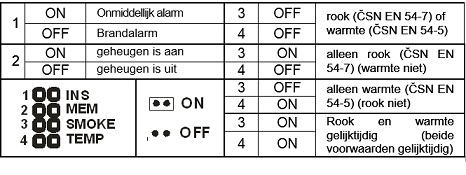
1 ON Immediate alarm 3 OFF smoke (EN 54-7) or heat (EN 54-5)
OFF Fire alarm 4 OFF
2 ON memory is on 3 ON only smoke (EN 54-7) (heat not)
OFF memory is off 4 OFF
3 OFF only heat (EN 54-5) (smoke not)
4 ON
3 ON Smoke and heat simultaneously (both conditions simultaneously)
4 ON
Forward connection 1 INS selects whether the detector, upon activation to the central station, triggers the fire alarm or immediate alarm (is used, when in ordinary situation smoke may occur - fireplace, cigarettes and the like.). It applies to the reaction set at the central office Fire or Immediate. If other than Basic Response is set by the F Link program, the control center will respond depending on the setting via Response in the peripheral devices map.
Forward link 2 MEM Signaling of alarm memory - if enabled, optical signaling on the detector remains active for 30 minutes after alarm status ends.
Forward connections 3 and 4 SMOKE and TEMP Combination of these forward connections determines whether the detector will react to smoke, heat, etc.
Fire alarm
Optical detector: After smoke enters the detector, alarm is activated, the red signal light starts flashing rapidly (approx. 8x per second). The indication remains on until the room is ventilated (and thus also the detector's detection chamber).
Temperature sensor: As soon as the temperature exceeds the limit set in the detector, alarm is turned on, the red signal light starts flashing rapidly (ca 8x per second). The indicator remains on until the temperature falls, e.g. by ventilating the room.
Alarm memory: If the alarm memory indicator is on, the signal light continues to indicate the activation of the detector by flashing for 30 minutes after the end of the alarm status. The indication can be stopped by activation of the tamper sensor by briefly unscrewing (twisting) the detector.
Tamper alarm: When the detector is unscrewed, it sends a tamper signal.
Testing and maintenance of detector
Operation of the detector can be checked by a test spray. The test should be performed once every 30 days. The detector should be regularly cleared of dust, cobwebs, etc.; no other maintenance is required.
Caution: Never test the detector by lighting an open flame in the object.
Replace batteries in the detector
The system automatically reports when the batteries are running low. A weak battery is also indicated by a flash every 30 sec. Before replacing the batteries in the detector, the system must be switched to Service mode (otherwise sabotage alarms will be called). It is necessary to always replace all three batteries at the same time and use the same type from the same manufacturer. After the batteries are inserted, an autotest starts automatically, checking the voltage of the batteries, the state of the detector and this information is sent to the central controller.
Indication of malfunction
The detector checks its own operation. As soon as a malfunction is detected, the indicator light keeps flashing rapidly for 1 minute and then three short flashes every 30 sec every time. In this case, take out the batteries for 1 minute and put them back in. If the light starts flashing permanently again after about 1 minute, take the detector to service.
Technical parameters
Power supply 3 pcs. alkaline batteries AA 1.5 V, 2.4 Ah)
Typical battery life approx. 2 years
Communication band 868.1 MHz, protocol Jablotron
Communication range approx. 300 m (free terrain)
Dimensions diameter 126 mm, height 50 mm
Weight 150 g
smoke detection optical dispersion of light
sensitivity smoke detector m = 0.11 ¸ 0.13 dB/m cf. CSN EN 54-7
temperature detection class A2 cf. CSN EN 54-5
alarm temperature +60°C to +70°C
operating temperature range -10°C to +80°C
Complies with CSN EN 54-5, CSN EN 54-7, CSN EN 54-25
Further complies with CSN ETSI EN 300220, CSN EN 50130-4,
CSN EN 55022, CSN EN 60950-1
Conditions of operation CTÚ VO-R/10/09.2010-11
Complies with requirements regulation No. 23/2008Sb. on fire protection of buildings
1293-CPD-0249
This product has been designed and manufactured in accordance with the subsequent provisions to be applied: Government Decree No. 190/2002 Sb., 426/2000 Sb., in current text, if used as intended.
Note: Although this product does not contain harmful materials, do not dispose of it in the domestic waste, but dispose of it at the collection point designated for electronic waste.
Detector placement
Smoke enters the detector through the flowing air - therefore, it must be installed in a place, where the air flows well thanks to a natural thermal circulation (usually to the ceiling). The detector can be used only in an enclosed interior. It is not suitable there, where the smoke can spread and cool down (e.g. high ceilings - more than 5 m) - the smoke then does not reach the detector.
In homes, the detector should always be installed in the area leading to the exit (escape route) see Figure 1. If the floor area in the house exceeds 150 m², another detector must be installed there, in another suitable part of the house, see fig. 2.
1. kitchen,
2. living room,
3. - 6. bedrooms
? / minimum coverage by detectors
? recommended coverage by detectors
Figure 1
Figure 2
Figure 3
It is recommended to install a detector in every room, where people sleep.
Install under horizontal ceilings
If possible, install the detector in the center of the room. Since a cold layer of air may form near the ceiling, the detectors should not be recessed into the ceiling. The fire detector must never be installed in a corner of the room (observe a distance of min. 0.5 m from the room corner, see Figure 4). In corners, the air circulates poorly.
Install under sloping ceilings
If the ceiling does not have a suitable straight surface (e.g. an attic room), the detector can be installed according to Fig. 5.
Figure 4
Figure 5
The center of the room, the best location, a possible location
Walls, partitions, obstacles, bare joists ceilings
The detector must be installed at least 0.5 m from a wall or obstacle. If the room is narrower than 1.2 m, the detector must be installed within the middle third of its width. If the room is divided into sections by furniture, shelving or half partitions, above which there is no more than 0.3 m distance from the ceiling, the individual sections should be considered separate rooms. In all Directions under and around the detector must leave a free space of min. 0.5 m. Any irregularity of the ceiling (such as a support beam), with dimensions greater than 5% of the ceiling height, are considered as walls where all the above remains in effect.
Ventilation and air movement
Detectors should not be installed directly at the outlet of ventilation, air conditioning and the like. If the air is introduced through a perforated ceiling, the ceiling must not be perforated 0.6 m in all directions around the detector.
Do not place detector:
- Where air flows poorly (niches, corners, ridges of ceilings on A-roofs and the like)
- Where dusty, smoky or steamy conditions prevail
- In places, where air flows intensively (close to fans, heat sources, mouths of ventilation, draught holes and the like.)
- in kitchens and damp rooms (steam, smoke and oily vapor may cause false alarms or detection failure)
- next to fluorescent or energy-saving lamps (electrical interference may trigger a false alarm)
- in places with large quantities of small insects
Caution: Most often, the detector becomes inadvertently active due to an incorrect installation location.
More detailed instructions for installation can be found in TS 54-14 and 34 2710.
Installation
When installing, follow the advice according to the previous paragraphs.
Figure 6: 1 - detach (remove) the detector; 2 - attach (set up) the detector; 3 - optical indication of status; 4 - orientation arrow for setting up; 5 - serial number; 6 - configuration junctions; 7 - place for inserting the batteries
1. Open the detector screen by turning it to the left (1).
2. Screw the plastic back panel to the selected location.
3. Set the configuration junctions (6) according to the table below
4. Continue to follow the installation instructions of the central unit. Basic steps:
a. In the F-Link program on the Peripherals card, select the desired position and start the learning mode with the Add button.
b. Inserting the last battery in the detector sends the learning code to the system - as confirmation of sending, the signal light (3) flashes briefly.
5. Place the detector on the plastic back panel. It can only be in one position, indicated by arrows (4) on both plastic parts. Turning the detector to the right (2) locks it in place.
Note:
The detector can also learn in the system by entering the serial number (5) through the F-Link program or through the keypad (or bar code reader). All digits below the bar code must be entered (1400-00-0000-0001).
Set detector
In the F-Link program on the peripheral devices card and using the jumpers in the detector, the properties of the detector can be set.
1 ON Immediate alarm 3 OFF smoke (EN 54-7) or heat (EN 54-5)
OFF Fire alarm 4 OFF
2 ON memory is on 3 ON only smoke (EN 54-7) (heat not)
OFF memory is off 4 OFF
3 OFF only heat (EN 54-5) (smoke not)
4 ON
3 ON Smoke and heat simultaneously (both conditions simultaneously)
4 ON
Forward connection 1 INS selects whether the detector, upon activation to the central station, triggers the fire alarm or immediate alarm (is used, when in ordinary situation smoke may occur - fireplace, cigarettes and the like.). It applies to the reaction set at the central office Fire or Immediate. If other than Basic Response is set by the F Link program, the control center will respond depending on the setting via Response in the peripheral devices map.
Forward link 2 MEM Signaling of alarm memory - if enabled, optical signaling on the detector remains active for 30 minutes after alarm status ends.
Forward connections 3 and 4 SMOKE and TEMP Combination of these forward connections determines whether the detector will react to smoke, heat, etc.
Fire alarm
Optical detector: After smoke enters the detector, alarm is activated, the red signal light starts flashing rapidly (approx. 8x per second). The indication remains on until the room is ventilated (and thus also the detector's detection chamber).
Temperature sensor: As soon as the temperature exceeds the limit set in the detector, alarm is turned on, the red signal light starts flashing rapidly (ca 8x per second). The indicator remains on until the temperature falls, e.g. by ventilating the room.
Alarm memory: If the alarm memory indicator is on, the signal light continues to indicate the activation of the detector by flashing for 30 minutes after the end of the alarm status. The indication can be stopped by activation of the tamper sensor by briefly unscrewing (twisting) the detector.
Tamper alarm: When the detector is unscrewed, it sends a tamper signal.
Testing and maintenance of detector
Operation of the detector can be checked by a test spray. The test should be performed once every 30 days. The detector should be regularly cleared of dust, cobwebs, etc.; no other maintenance is required.
Caution: Never test the detector by lighting an open flame in the object.
Replace batteries in the detector
The system automatically reports when the batteries are running low. A weak battery is also indicated by a flash every 30 sec. Before replacing the batteries in the detector, the system must be switched to Service mode (otherwise sabotage alarms will be called). It is necessary to always replace all three batteries at the same time and use the same type from the same manufacturer. After the batteries are inserted, an autotest starts automatically, checking the voltage of the batteries, the state of the detector and this information is sent to the central controller.
Indication of malfunction
The detector checks its own operation. As soon as a malfunction is detected, the indicator light keeps flashing rapidly for 1 minute and then three short flashes every 30 sec every time. In this case, take out the batteries for 1 minute and put them back in. If the light starts flashing permanently again after about 1 minute, take the detector to service.
Technical parameters
Power supply 3 pcs. alkaline batteries AA 1.5 V, 2.4 Ah)
Typical battery life approx. 2 years
Communication band 868.1 MHz, protocol Jablotron
Communication range approx. 300 m (free terrain)
Dimensions diameter 126 mm, height 50 mm
Weight 150 g
smoke detection optical dispersion of light
sensitivity smoke detector m = 0.11 ¸ 0.13 dB/m cf. CSN EN 54-7
temperature detection class A2 cf. CSN EN 54-5
alarm temperature +60°C to +70°C
operating temperature range -10°C to +80°C
Complies with CSN EN 54-5, CSN EN 54-7, CSN EN 54-25
Further complies with CSN ETSI EN 300220, CSN EN 50130-4,
CSN EN 55022, CSN EN 60950-1
Conditions of operation CTÚ VO-R/10/09.2010-11
Complies with requirements regulation No. 23/2008Sb. on fire protection of buildings
1293-CPD-0249
This product has been designed and manufactured in accordance with the subsequent provisions to be applied: Government Decree No. 190/2002 Sb., 426/2000 Sb., in current text, if used as intended.
Note: Although this product does not contain harmful materials, do not dispose of it in the domestic waste, but dispose of it at the collection point designated for electronic waste.